
The revolution isn't coming. It's already here.
One retailer. Ninety days. $157,922.80 of dead capital pulled off the shelves — and when the marketing switched on, $2,100 of attributed revenue in fourteen days. Not a pilot. Not a roadmap. This already happened.
Capital out. Revenue in.
Ninety days in two pictures. Six figures of cash walks off the shelves and back into the business — and the marketing line leaves zero the day it's switched on.
View as table
View as table
You activate. It works that week.
There is no implementation project. No six-month rollout, no data-cleanup phase, no "that's on the roadmap for Q3." RunOps reads your POS on day one and starts producing work you can act on — the customer list was already built before the first campaign was sent.
The platform paid for itself many times over.
RunOps Core is $1,500 to set up and $500 a month at base — $7,500 for a full first year. Set that against what the first ninety days actually returned. This isn't a projection or a modeled ROI: it's her inventory line and her campaign revenue, against the published price on our own pricing page.
Base pricing shown: RunOps Core is $500/mo covering up to $500K of inventory at cost, +$100/mo per additional $100K above that, so a larger position pays more than the base — even doubled, the first-year cost is still a fraction of what came back. Freed inventory capital is a one-time release, not recurring revenue; attributed campaign revenue is revenue, not margin. Your numbers will be your own.
Read the register. Then do the work.
Every number above came from the same spine: one system that sees the inventory, the sell-through and the customer at once — and hands back the order, the markdown and the campaign already drafted.
Bought against sell-through
Fill-ins and reorders drafted from live sell-through against her open-to-buy — money going back into what moves, not a repeat of last season.
Surfaced the dead stock
What hasn't turned gets a name, a number and a recommended markdown or transfer — the slow bleed a POS report never shows you.
Marketed to who already bought
One customer record per shopper, RFM and lifecycle segments rebuilt nightly, campaigns drafted off the same inventory data and sent from her own domain.
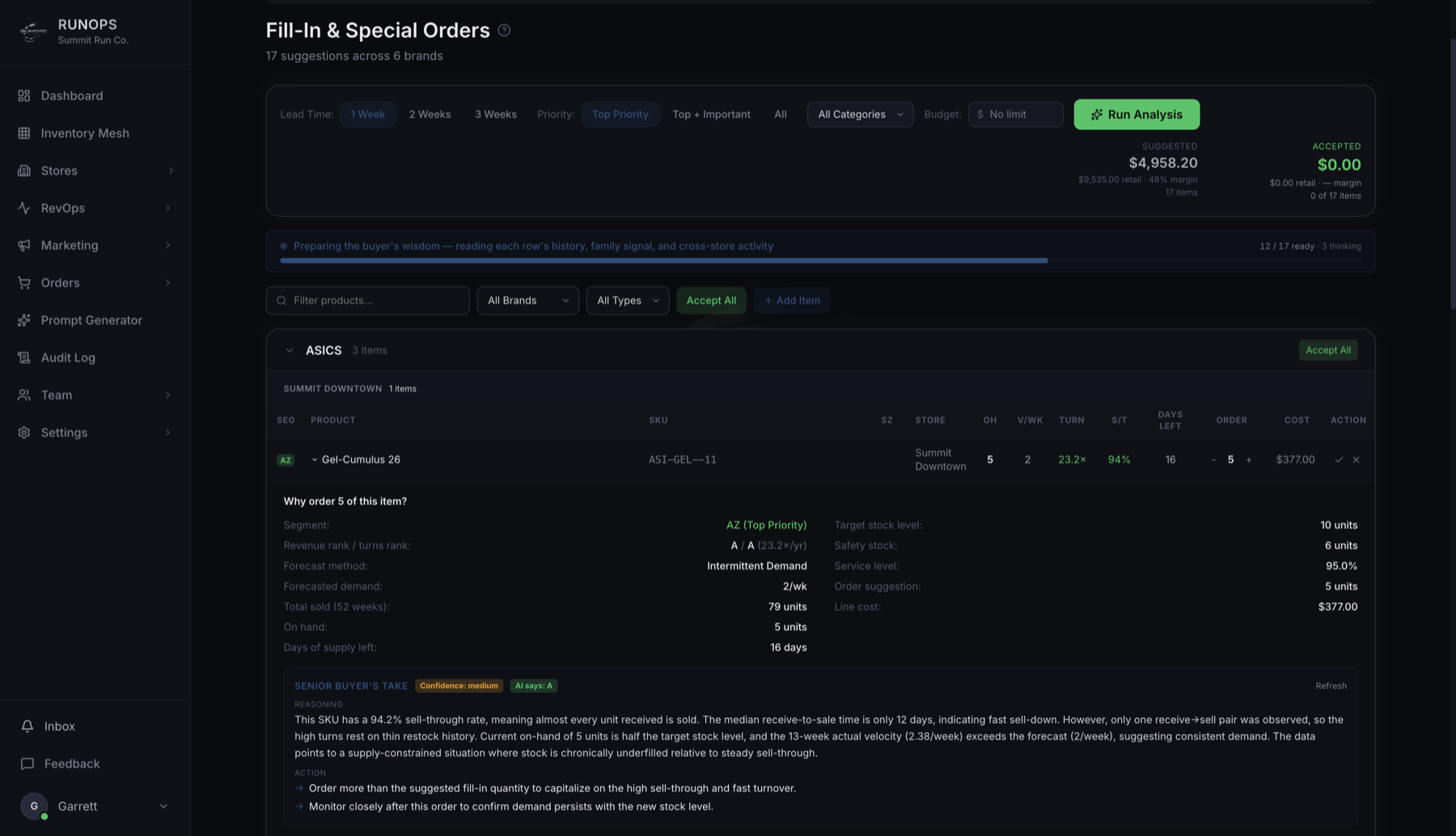
This is the screen that moved the inventory line: every recommended quantity comes with the sell-through that justifies it, so she is approving decisions rather than building spreadsheets.
Same team. Same floor. Different business.
Nothing about the store got bigger. The back office behind it did.
- $813,678.80 of inventory on the shelves, a growing share of it not turning.
- Reorders written by hand, from gut feel and a POS export.
- A customer list trapped in the register, never marketed to.
- Buying, marketing and labor decided in three different places, on three different sets of numbers.
- $655,756.00 carried — $157,922.80 back in working capital.
- Orders arrive drafted from live sell-through — she approves, the rep gets the email.
- Every shopper is a customer record — segmented, marketed to, measured in dollars.
- One spine. The campaign knows the inventory; the inventory knows the sell-through.
- Who
- An independent specialty running retailer. Named details withheld at the owner's discretion.
- Window
- 90 days on RunOps for the inventory result; the first 14 days after launch for the marketing result.
- Inventory source
- Total inventory value as reported by her POS: $813,678.80 at the start of the window, $655,756.00 at the end. A decrease of $157,922.80, or 19.4%.
- Marketing source
- $2,100 of revenue attributed by RunOps to campaigns sent in the first two weeks the marketing module was live for her.
- Pricing basis
- Payback figures use published RunOps Core base pricing — $1,500 one-time setup plus $500/mo — for a $7,500 first year. Core scales at +$100/mo per $100K of inventory at cost above $500K, so a larger position pays more than base. See offerings.
- What RunOps did
- Read-only POS sync, AI-drafted fill-in orders and reorder/transfer recommendations, one unified customer record, automatic RFM & lifecycle segmentation, and AI-drafted email campaigns sent from her own domain.
Results are from a single RunOps customer over the periods described and are not a promise of future performance — your inventory position, sell-through and customer file are your own. RunOps reads from your POS; every order, markdown and campaign is approved by you before it goes out.
She isn't waiting for retail to catch up. Neither should you.
Connect your POS and watch the first ninety days. $1,500 to set up, $500 a month at base — and no part of this needs an implementation team.